Tuesday, November 14, 2006

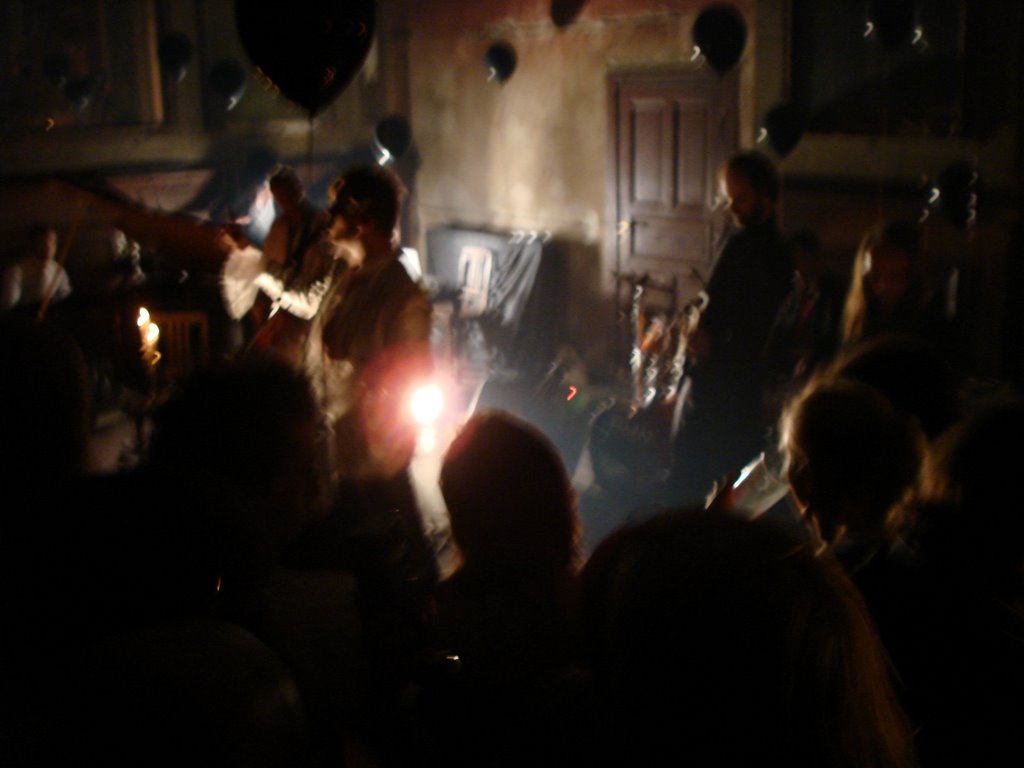
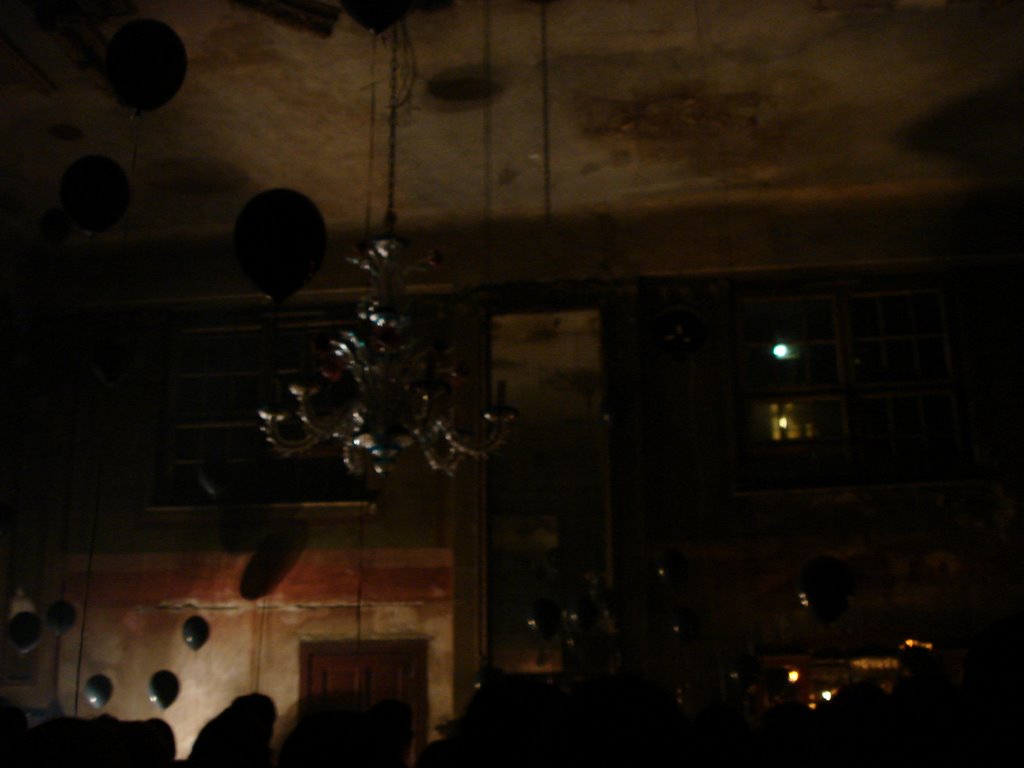
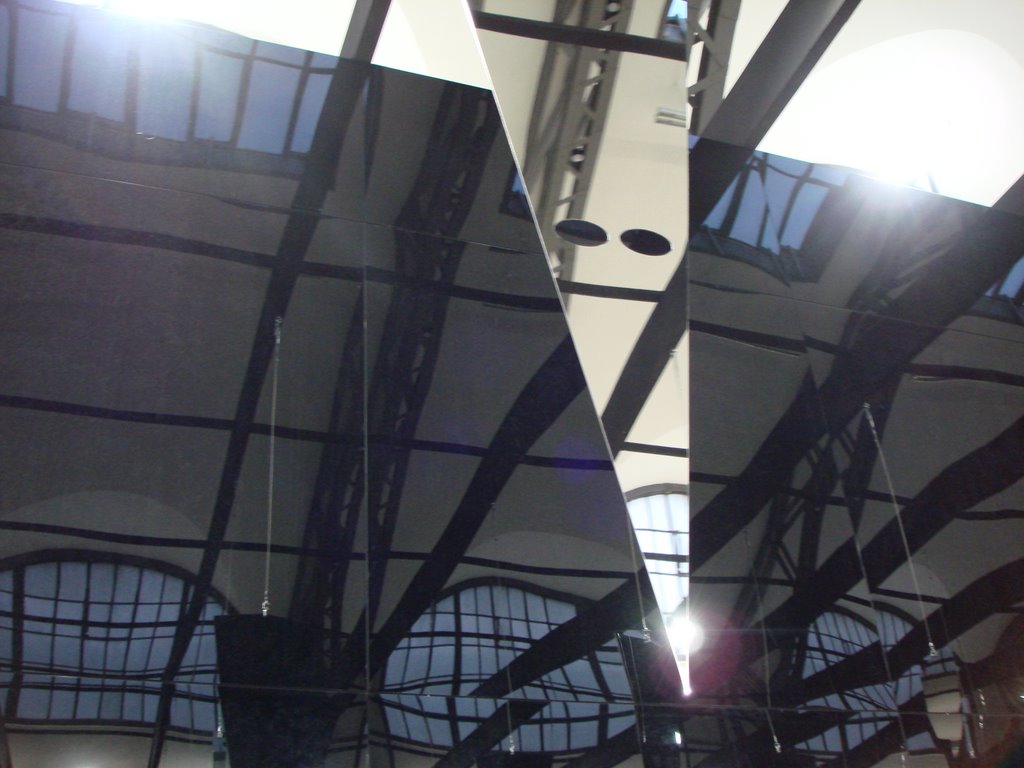
Claude Lévêque, Hymne, 2006 - Berlin


In the Hamburger Bahnhoff museum for contemporary art here in Berlin i saw this amazing installation by:
Claude Lévêque, an artist wich i had never heard of.
It´s an amazing experience to stand in this very teccie almost 80´s like discotheque kind of enviroment with kkk hood shaped mirrors hanging upside down from the ceiling.
At first you feel attracked to enter the room and an almost laughable feeling came over me as i had the feeling that i entered the set of the Flashdance movie, then at that moment you realize that these sharp elements are hanging on a thin wire discomfort overwhelms you and cold shivers run over your back.
What if...


http://images.google.nl/images?q=claude+leveque+&svnum=10&hl=nl&lr=&start=20&sa=N&ndsp=20
http://www.alltheweb.com/search?cat=web&cs=iso88591&q=claude+leveque+&rys=0&itag=crv

Sunday, October 29, 2006

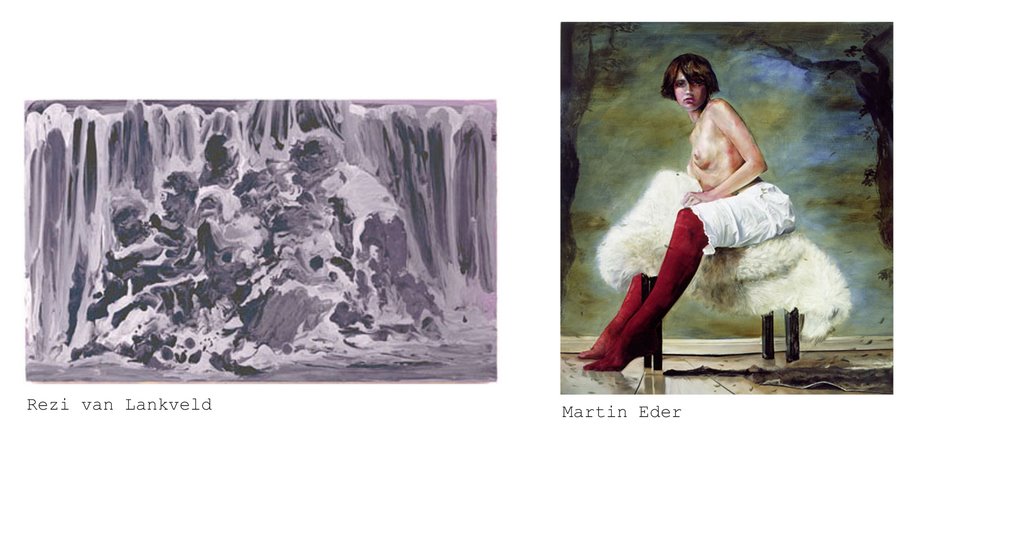
GEM Nederland Deutschland Malerei


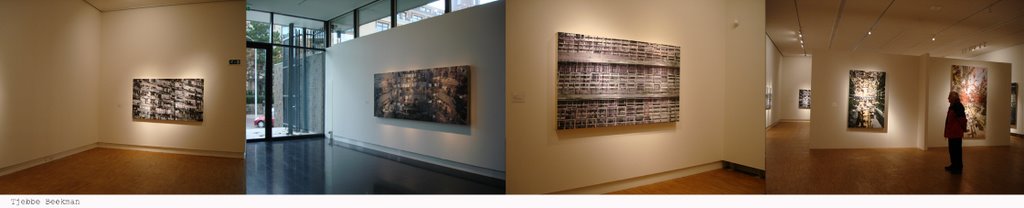
Tjebbe Beekman
David Schnell
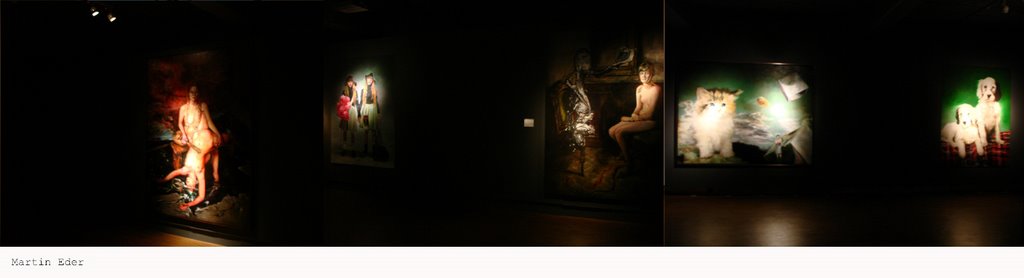
Martin Eder
Mathias Weischer
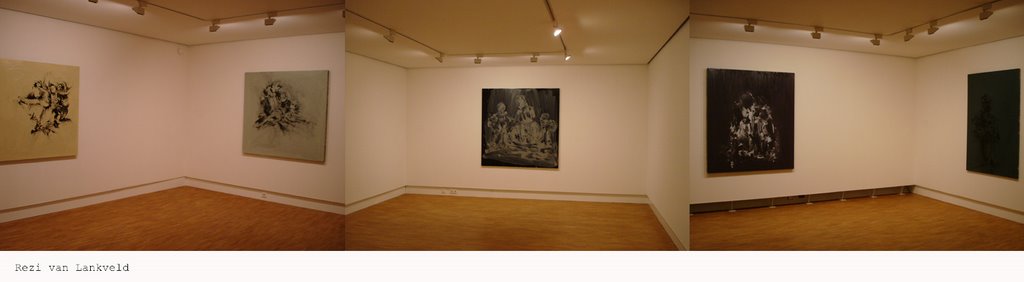
Rezi van Lankveld
Aaron van Erp


Tjebbe Beekman is also showing new works at Diana Stigter Gallery in Amsterdam.


Painting The Netherlands - Germany Malerei

Open from 21 october 2006 - 21 january 2007


Friday, October 06, 2006

florentijn hofman

USA Today


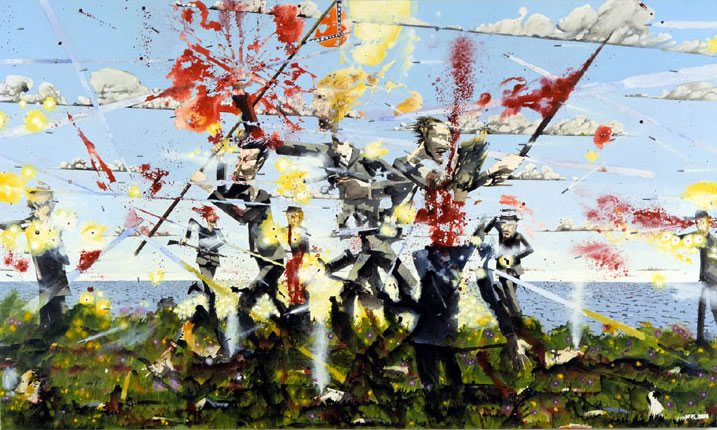
Barnaby Furnas

Hamburger Hill

2002
Urethane on linen

182.9 x 304.8cm


Jules de Balincourt

Internal Renovations

2006, Two panels, acrylic, oil and spray paint on panel
220 x 300 cm


Schlock and awe

After Iraq, Katrina and Abu Ghraib, what should we expect from US artists? More than Saatchi's show delivers, says Adrian Searle

Thursday October 5, 2006

One can forgive current American art a degree of querulousness, ambivalence and doubt about itself and its place in the world. One might expect it to be critical of the culture of which it is a part, and expect it to be cynical as well as satirical. How could it be otherwise? USA Today, the Royal Academy's exhibition of new art from America, all collected by Charles Saatchi, is certainly bold. Whether it adds up to a statement, or defines a zeitgeist, is another matter.

It has a sense of anxiety and self-loathing; amid this are angry protests, displays of mock insouciance, and tragicomic buffoonery. Ryan Tracartin's sculptures made me laugh out loud. At 25, he is as much a film-maker as a sculptor, and his sculptures look like props. Until Hurricane Katrina, he was based in New Orleans. World Wall is a kind of childish grotto, with bits of bodies poking out of the walls, a huge, cave-like open mouth where a living room once stood, mad bulging eyes, a house whose roof is painted over with waves. An unnaturally skinny naked mother stalks the floor, head aloof. The unattractive but game Vicky Veterinarian has a cat burrowing in her shirt. Mango Lady's skin is made from mango peel. The characters are all in search of a plot, but there isn't one.


The painted and sculpted human beings throughout USA Today seem variously dumb, stupid, aggressive, abject, forlorn, ridiculous, damaged, sick, in distress, screwed up. This can be no coincidence. Or perhaps Saatchi has a taste for this sort of thing, this dismal view of the world. Almost everything else here shouts, screams, lacerates itself in self-loathing, hectors, assaults, appals, insults.

In Fuck the Police, Dash Snow presents 45 framed press clippings: Cops Busted in Sex Abuse, Cops Who Killed For Mafia, Cop in Coke Ring. The catalogue tells us Snow "started taking photos when he was a yobbish teenager", and that the headlines are all "splattered with jism". Well, that changes everything.

Perhaps the most telling sculpture is an anonymous figure, either cowering or in prayer. The body is a black bin-liner. Brown clay hands reach forward, palms flat on the floor. Behind the figure is a trail of crumbled clay. Huma Bhabha's sculpture has an odd vulnerability, however curtailed an image of a human it presents.

After 9/11, after Hurricane Katrina, after Iraq, Afghanistan, Guantánamo, what should one expect from American culture, apart from rage and crawl-into- a-hole-in-the-ground-and-die abjection?

Perhaps that is what LA-based Jon Pylypchuk intends: his miserable little figures, touchingly dressed in remnants of fabric, stagger about on the floor, gather helplessly around the wounded, vomit in shock on the ground and upon each other. It is a horrible roundelay. All this goes on at ankle height. "Hopefully, I will live through this with a little bit of dignity," the title reads. Dignity is in short supply here. How about 222 plaster, wax and charcoal heads, each damaged in some way, each set inside a grubby little vitrine, in Beijing-born Terence Koh's Crackhead? Koh can't be accused of subtlety, any more than Banks Violette and her sculptural tableaux.

Violette's work is sculpture that wishes it was as edgy as a death-cult heavy metal band, but is about as dangerous as Spinal Tap. His casts of electric guitars, mock amplifiers and drifts of salt and sugar faking cocaine have schlock value, but little else.

In Barnaby Furnas's paintings, men in suits are being turned to mincemeat in a shoot-out on Hamburger Hill, and a flood of urethane red, like a bloody response to the poured and stained 1960s colour field paintings of Morris Louis, roars through a blue sky in another mammoth canvas. I can just see this sanguinous deluge displayed with pride in some American corporate lobby somewhere. That is one of the problems with art that attempts to make statements: it gets assimilated.

Paint becomes snot in a painted sneeze by Dana Schutz; she paints feelings as though they were regurgitated food. In one canvas, a head eats its own face, as well it might.

Schutz's paintings are at least funny and intelligently made. There are some silly paintings in this exhibition: a self-consciously badly painted decapitated horse with a huge penis, bluntly crass paintings of bits of bodies, Gerald Davis's deeply unpleasant paintings of adolescent sexuality.

Davis paints pubescent Monica giving head, and an x-ray view of teen Linsey's full colon, accompanied by a painted diary entry about her exquisite bathroom experience in the shopping mall. Where do we go with images like these? Am I meant to admire their more abstract qualities, or feel all smug at their sophisticated ironies?

USA Today is neither as good as I wanted it to be, nor as bad. When I say bad, I mean angry, lacerating, bitter, disillusioned, pained and powerful. In New York's Whitney Biennial, Richard Serra showed a rough little drawing of a now familiar image: a figure hooded in black, standing with outstretched arms on a box, waiting, so he thinks, to be electrocuted. "STOP BUSH," Serra scrawled on the drawing.

It may not be great art, but it doesn't need to be. That's the problem. I want an art more powerful - not just loud, not just blunt. Most of art's audience already know what they think about the state of America and the war on terror. The job of artists, novelists, film-makers, musicians and playwrights demands that they go further than stating the obvious. USA Today is an expression, more than anything, of impotence.

· USA Today is at the Royal Academy of Arts, London W1, from tomorrow until November 4. Details 020-7300 8000.
Wednesday, October 04, 2006

Turner Prize 2006


Personal Favorite : Mark Titchner

http://www.londonart.co.uk/editorial/private_view.asp?id=183

http://www.tate.org.uk/britain/turnerprize/2006/


It's Turner prize time again: the annual occasion for a national punch-up over contemporary art, when four artists are lined up in order to be pilloried, praised and passionately fought over before one of them - not infrequently, the one least expected to do so - is awarded a cheque for £25,000.

It is, in short, always something of a soap opera, which is why it is particularly appropriate that, as part of his section of the exhibition at Tate Britain in London shortlisted artist Phil Collins has set up a fully operational TV production office, called Shady Lane Productions.

The office, with its phalanxes of lever-arch files and ugly house plant, will be up and running each weekday from 10am till 6pm. The only difference from a normal office is the glass wall that separates it from the gallery, through which visitors will be able to observe the employees going about their daily business.

Collins is asking members of the public to contact the office if they have had a damaging experience as a result of appearing on a reality or makeover show.

He will then invite participants to tell their side of the story, unedited, for a resulting programme called The Return of the Real, a sort of "what-happened-next". Collins's own reaction to his shortlisting was: "I thought about it for a week. It felt like that moment in [the film] Carrie when she has a bucket of blood thrown over her and is made a fool of on a grand scale."

Lizzie Carey-Thomas, one of the Tate curators who has put together this year's exhibition, said that this year's artists "cover all bases". Apart from film-maker Collins, the other shortlisted contenders are a painter, a sculptor and an installation artist. It is the second year running a painter has made the shortlist. Tomma Abts's non-representational oils, unvaryingly 38cm by 48cm, are made, as Ms Carey-Thomas put it, "with no source material, no sketches and no preconceived idea of how they will end up". Working with a combination of utter precision and total intuition she applies paint until, gradually, a shape emerges, though the work may go through wildly differing stages before the final form is found. Ms Abts says that the painting is complete when "it suddenly has an atmosphere and makes you feel something". The work is then given a title using a dictionary of first names from a particular region of Germany.

The other contenders are Rebecca Warren, whose clay sculptures reference figures such as Rodin and Dégas and whose lumpy, bumpy, hyper-feminine forms gently debunk her artistic forebears; and Mark Titchner, whose installations draw on defunct belief systems and outmoded science to "question the codes by which we live today", according to Tate curator Katharine Stout.

The unveiling of the exhibition was, however, overshadowed by comments made at the weekend by one of this year's jurors. Journalist Lynn Barber, writing in the Observer and breaking the convention that jurors remain silent at least until the prize is awarded, quoted an extract from her diary saying that she felt "demoralised, disillusioned, and full of dark fears that I have been stitched up - that actually the art world has already decided who will win the 2006 Turner prize and that I am brought in purely as a fig leaf". She also said the experience of being a Turner prize judge had "seriously dampened" her enthusiasm for contemporary art and that she had tried to "warn off" a colleague, writer Miranda Sawyer, from accepting an invitation to become a juror for the 2007 prize.

Stephen Deuchar, director of Tate Britain, said of Barber's article: "I think it was tongue in cheek. This was a very personal account of how she found the process and very good-humoured. I'm very relaxed about it - she's very engaging and slightly self-deprecating and honest."

This year's prize is awarded in a ceremony at Tate Britain on December 3. The winner will receive £25,000 and the runners-up £5,000 each. This year's jurors, apart from Ms Barber, are Margot Heller, director of the South London Gallery; Matthew Higgs, director of White Columns gallery, New York; and Andrew Renton, director of the curating course at Goldsmiths College, University of London. Chairing the jury is Tate director Sir Nicholas Serota.

According to Sir Nicholas, the prize "cannot possibly cover the full range of new developments, nor survey all that is important in contemporary art in Britain. Nor is the prize intended either as a long-service medal, or as a forcing ground for new talent. It answers the simple questions, what were the exhibitions, which were the works of art and who were the artists whose work had the strongest and most enduring impact this year on this group of individuals, the jury?" To be eligible artists must be under 50 and living or working in Britain. Previous winners since the prize's inauguration in 1984 have included Martin Creed (2001), Chris Ofili (1998), and Damien Hirst (1995).

Thursday, September 21, 2006

Luc Tuymans


THE TRUTH OF THE MATTER 

Owen Drolet
Tsjombe, 2000. Oil on canvas, 73 x 108 cm.
Courtesy of David Zwirner, New York.

LUC TUYMANS,

LIKE his fellow painter Gerhard Richter, utilizes found as well
as self-made photographic imagery, taking
a serious speculative interest in the endlessly intertwined relationships
between all forms of image making, from drawing and photography
to television and cinema, and ultimately to history, memory, and cognition itself.
Tuymans and Richter also share the premise that nothing seen can be believed,
dismantling with haste any old-fashioned notions you might
have had about the possibility of veracity.
But Richter, having come of age in the middle of the last century,
is a modernist at heart and therefore always strictly concerned
with the limitations of his medium.
Photography, however ingrained in his practice, still represents a challenge to

painting or, at the very least, an instrument with which to
further clarify its boundaries, and this is precisely why his technical
virtuosity can have such perverse charm.
Yes, we see that photographs, like other works of art, are composed forms
of rhetoric rather than factual' documents, but mostly he presents
us, over and over again, with dazzling displays of what painting can't do —
like early Frank Stella but figurative.
And the better he paints them, the more stunning the spectacle he creates,
the more poignant his endgame becomes.
Tropical Institute, 2003. Oil on canvas,
156 x 139 cm . Courtesy of David Zwirner, New York

With Tuymans we jump from endgame  to postgame wrap-up, a commentary on the
commentary and yet one freed from the
burdens of solipsism. What Richter repeatedly proves to us, Tuymans takes for
granted.
As a former filmmaker, he is clearly at ease with other media and has fully
assimilated their various rhetorical
biases.
Painting has no special place in his world and requires no defending or even
articulating. It is just a quiet
corner of the
densely populated media landscape, one that lies to us as regularly as our
televisions.
These lies and omissions, however, are not examined through the prism of painting's particular
epistemology but rather are
the rhetorical nature of all speech.
Whereas Richter must be proficient and complex in order to show us the precise ways
in which painting (perhaps the oldest
form of complex cultural communication) fails, Tuymans uses a sort of false modesty
to allow us to see again how it can succeed — the
joke being that success and failure in this case are largely the same thing.
That paintings lie has been for Richter a fact of self-defining but glorious
limitation.
In Tuymans' hands it becomes a humble acknowledgement of the medium's wider
relevance as history, memory, and
even ‘media memories' continue to merge in our lives into one big blur.
Dancing, 2003. Oil on canvas, 120 x 80 cm
Courtesy of Zeno X, Antwerp.
This is why we shouldn't expect or require an individual masterpiece from Tuymans.
The strength of the paintings is cumulative in effect, which is in keeping with our
media saturated times.
His is a project as much about its conceptual conceits and overriding thematic
concerns as it is about specific paintings.
Consider his work for the 2001 Venice Biennale and its confrontation with the
largely forgotten legacy of Belgian colonialism.
As individual works, the paintings' mysterious and ghostly images of Patrice
Lumumba and the men who colluded in his murder can
easily sink into an unsatisfying non sequitur, but viewed together their meaning
grows in comprehensibility without necessarily
restricting its scope.
It has long been derisively argued by many painters that simply hanging a
painting on a wall constitutes an installation, but Tuymans truly is
an installation artist, working with discrete hand-made props rather than the
usual readymade assemblages.
The result has been a series of exhibitions whose larger, quietly theatrical
dynamics reinforce those found within the individual
canvases as we turn our attention from one untrustworthy image to the next.
First and foremost, however, Tuymans remains a painter of mood.
The canvases are linked not only by their reduced palette of modulated grays
(the unofficial color of memory), but also by their uncanny
sensation of ill-defined dread that turns seemingly mundane circumstances into
enigmatically portentous scenarios.
This strange feeling, so difficult to pinpoint and therefore pleasantly at odds
with the more concept-driven aspects of his project, is
what, over time, has most distinguished the work.
When first encountered, the paintings can seem crude, inarticulate even, until
that unsettling sensation descends like a fog.
Soon, the simplest portrait or commonplace interior feels terribly freighted —
but with what? History? The burdens of representation itself?
So it would seem, though there is no way to know for sure.
All we can be certain of is that something isn't quite right, which leads us as
spectators to Tuyman's larger point: that nothing ever is.


Owen Drolet is a critic and writer based in New York.

Wednesday, September 20, 2006

Gerhard Richter


All works by herr Richter are online, enough material to spent two days behind your computer!

via art-bbq

Sunday, September 17, 2006

Armen Eloyan


Watch the new show of Armen Eloyan here: http://vernissage.tv/blog/2006/09/07/armen-eloyan-comic-related-paintings-bob-van-orsouw/

I don´t want to guess how he broke two arms at once....
Altough smoking like that ... very classy Armen!!!!!!!!!

Wednesday, September 06, 2006

Kristof Kintera new website

www.kristofkintera.com


Finally there´s a website of Kristof Kintera´s work!!!

NEW FIELDS OF ARCHITECTURE: ZAHA HADID


Zaha Hadid, The Peak: Blue Slabs, 1983, acrylic on paper, 111 x 72 1/6". From the project The Peak, Hong Kong, 1982–83.

Zaha Hadid, Habitable Bridge, 1996, London. Model.


Zaha Hadid, Department of Islamic Art, Musée du Louvre, 2005, Paris. Rendering.


Tuesday, September 05, 2006

Opening Martin Eder


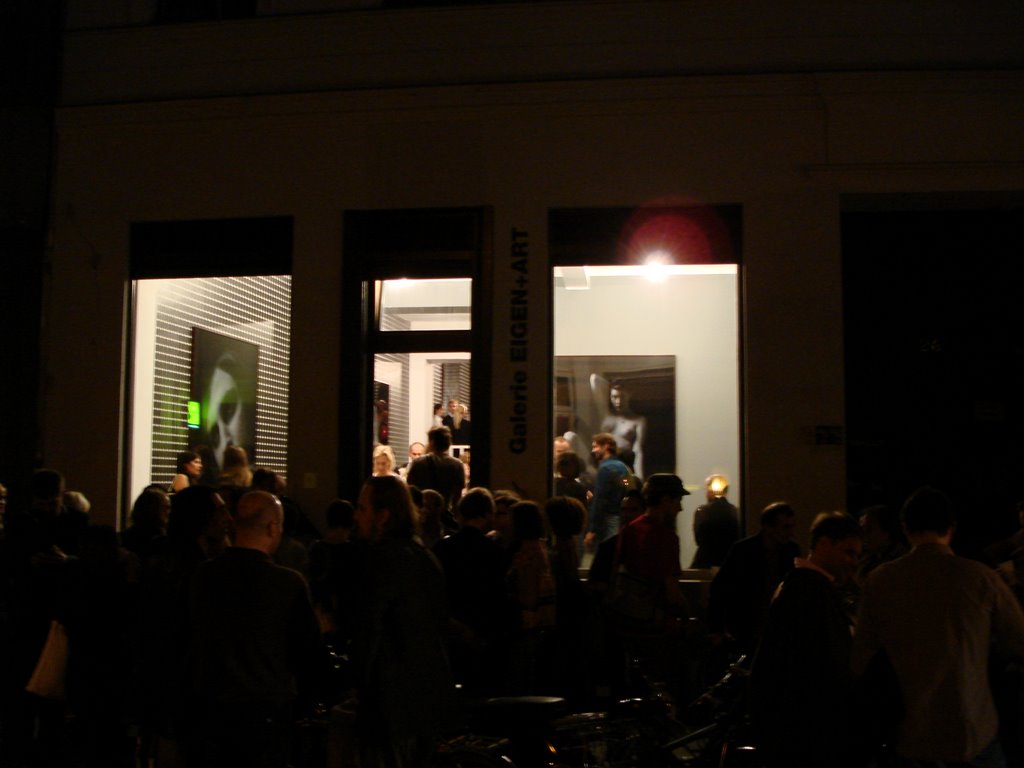
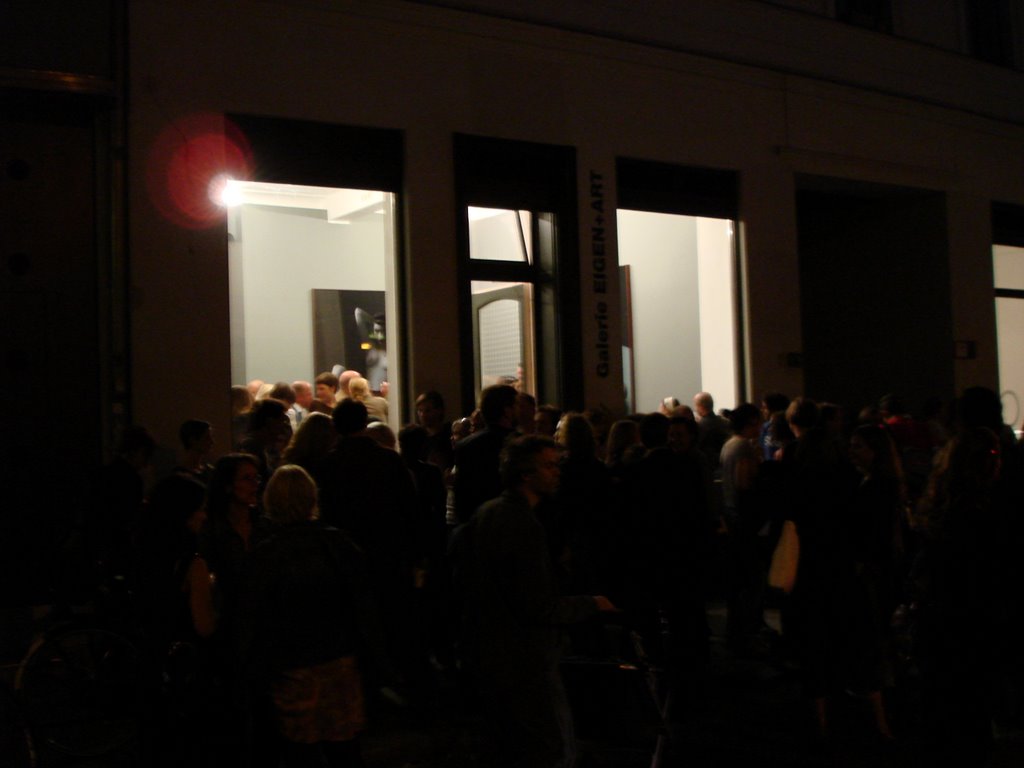
Martin Eder opened a show with new works at the Eigen + Art Gallery Berlin.
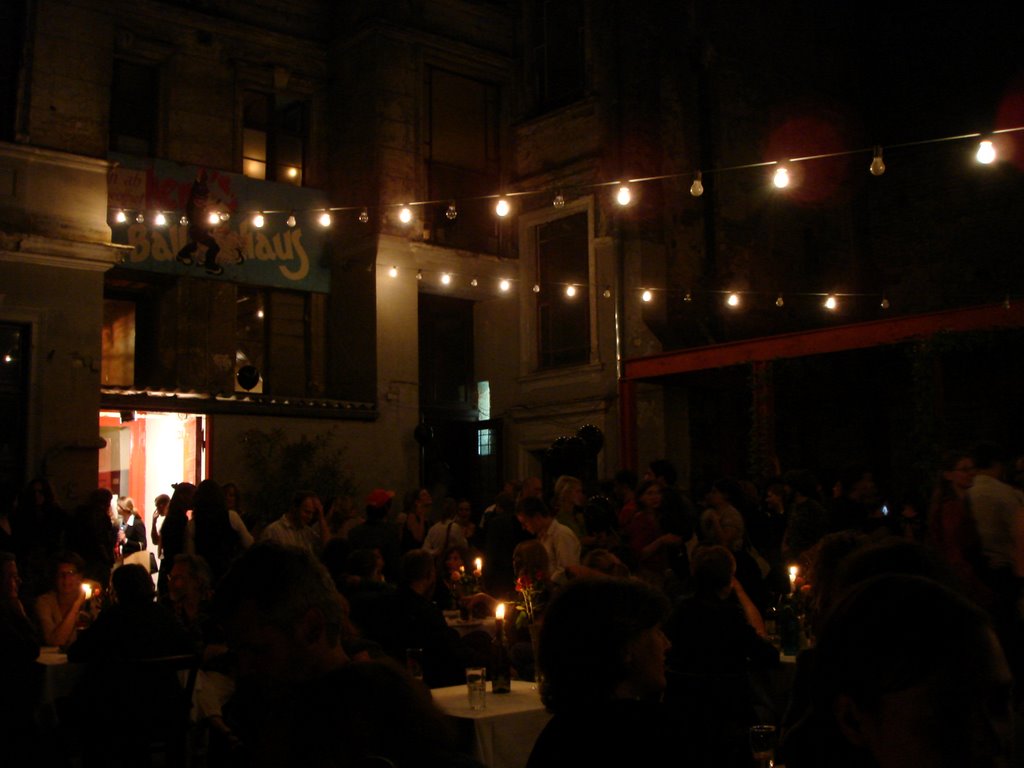
Although the works weren´t that great in my opinion, it was absolutely an art event and later in the evening the artist played with his trashy night club band in the beautifull ballhaus, wich was absolutely brilliant.
It was amazing how many art victims etc. turned up for just two openings in Auguststrasse.
There was a show at KW and the one above.
KW i don´t have photographs of, sorry.
Art=Hip here in Berlin.

Saturday, September 02, 2006

season of openings has started


Well summervacation is kind of over. The first real opening in months took place at the Kunstraum Kreuzberg/Bethanien yesterday. I had the feeling that this overwelming crowded happening took some ajustments from my part, but it was very nice to see our friends Susanne and Sasha again. The exhibition: How to do things...in the middle of (no)where included work by Sasha (real name Alexander Komarov wich is shown on the photographs, he made a kind of paralel between a prisoner or prison life and the way an artist moves in his studio, i don´t do him justice with this very short description of his work wich includes many more layers but i have to be off and running to the next opening today of Martin Eder wich will probebly feature here tomorrow.

Wednesday, August 30, 2006

inside the studio


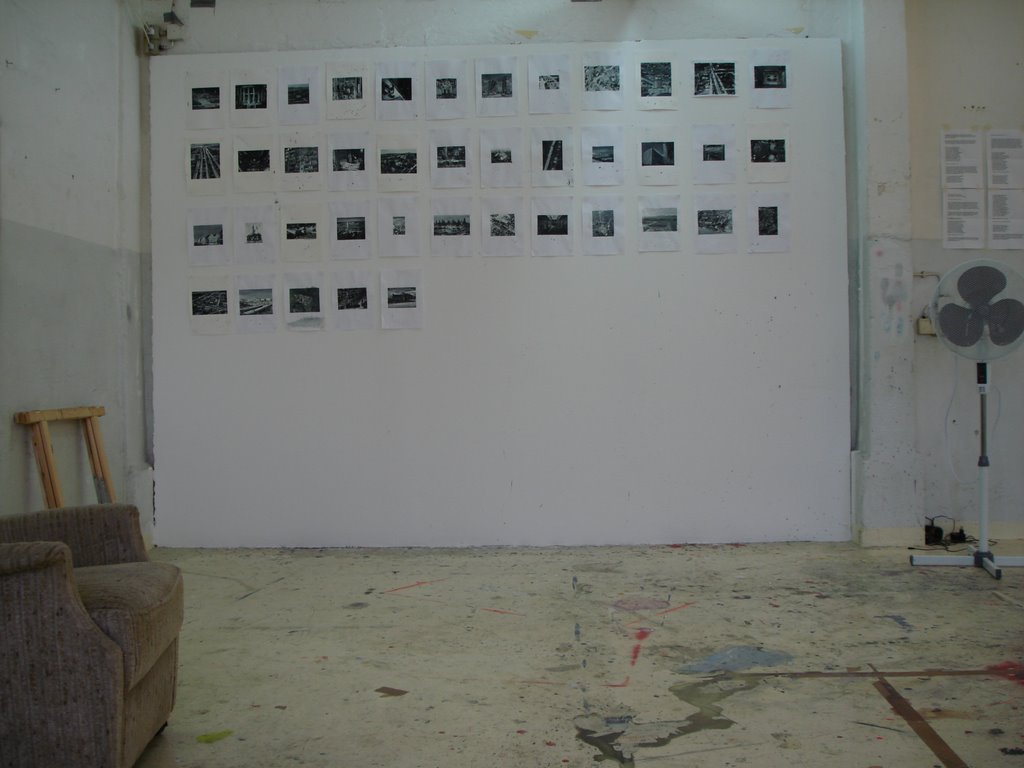
Wall of small sketches that i´m working on and very carefully like to share with you.

Saturday, August 26, 2006

INTINTERVIEW: Jason Rhoades & Michelle Robecchi

WHEN he was a kid, Jason Rhoades found gold in his property while digging around with a shovel. This episode, that he describes as a ‘discovery glitch myth’, undoubtedly left a deep mark on his life, and is probably the key to read most of his work from. Just think of what a primal experience finding a little glimpse of gold in nature is and you realise why Rhoades is an artist that hunts 500 euphemisms for the word ‘pussy’, brings a live tuna to Mecca, and buys and displays a catalogue of 27 eight-count Ivory Snow PeaRoeFoam boxes all at once. The inflammatory combination of sex, religion, food and fetishism behind Rhoades’ gigantic installations can be summarised with the struggle of researching and the pleasure of discovery – two acts of faith that he considers mandatory, not only in his work but in his ideal audience too. In Rhoades’ view, visiting an exhibition should be a bit like taking a pilgrimage to Jerusalem, Rome or Mecca, and the latter option – obviously less familiar to a Western audience – was the perfect subject for a trilogy that started in New York at David Zwirner in 2003, continued in St. Gallen at the Sammlung Hauser & Wirth (2004) and that finally landed in London last year on the occasion of the ‘Black Pussy’ exhibition at the London Hauser & Wirth gallery.

MICHELE ROBECCHI: What’s the connection between the three pieces?

JASON RHOADES: The Meccatuna (2003) piece in New York started out as a very simple idea to take a live tuna on a pilgrimage to Mecca. I tried to figure out how to do it, if it was possible or not, and it turned out it was hard. To keep the tuna alive, you have to keep it swimming. But I thought it would have been very beautiful to take a tuna to Mecca. And then it went to Sushi Tuna, and that was also hard. Then it turned into Canned Tuna. That’s the one I achieved for the show in New York. Meccatuna was a really simple thing – I thought it was a word that meant ‘everything’, like the whole shebang, the whole kit n’ kaboodle, the whole Meccatuna. It turned out that it wasn’t really a word yet. But then I still tried to push through and have it achieve its wordliness. It comes from this idea of a pilgrimage of going to see something, like in Egypt and Morocco where they paint your trip to the Kaaba on the side of your house or something. There’s that folk art image of that thing. Then I figured out I couldn’t go there because I’m not Muslim. So that pushed me even more – I was even more interested. My Medina was this pussy mosque that we built in St. Gallen. It’s beautiful. And that was just a very simple idea to build the pussy mosque, something I thought should be done. You know I collect these pussy words from all parts of the world in English and whatever, Spanish, and we have over 3,500 now that we will work from – linguistically harvesting these things. They have to be proven somehow. That’s just a very simple relationship between – it’s a strange thing, what euphemism, analogies, second word for something. Like in this cockney rhyming one – Sigourney Weaver = beaver. I like the way it interacts with us socially and sexually and intimately and yet kind of worldly. It places us in the world and it places us with language where we’re situated. Anyway, I just found it amazingly interesting as something to collect. Do you collect them?


MR:
Um, no.

JR: Not yet. Maybe you will.

MR: Maybe. I’ve only collected empty cans so far.

JR: Really? I’d been interested in that. Do you want to sell your collection of empty cans? How many cans have you got?

MR: Thousands, I think.

JR: Like stacked, or wrapped in boxes? Where are they now?

MR: They’re in boxes at my mother’s house now. It was a very Warholian thing – collecting things, put them in a box and move on. Did you collect something when you were a child?

JR: Yes, various things, but I’m not a big pack rat. I don’t like to keep them. I like stuff that I can have for a while.

MR: You clearly enjoy the search though.

JR: Yes, it’s all about searching.

MR: Your interest in Islamic culture nowadays must bring a lot of attention, given the current political situation.

JR: Yes, it’s good advertising. I started off fascinated with it because we don’t know about it. It’s not really taught and it’s not really clear. So I think my job as an artist is just to pull back the skin of something and expose parts of it. Not in a weird, aggressive way. Trying to be sensitive, but having no morals or no fundamentalism about it. I was fascinated by this Kaaba forever as a piece of art – I thought it was a sculpture. It’s a great sculpture from Abraham and the Pagan idolatry. Even in Islam, this big black cube, you go around it.

MR: It’s a challenging combination of different religious items.

JR: Yes. Mohammed adapted a lot of early elements, took it to serve the purpose of his trip.

MR: The Santa Sophia mosque in Istanbul presents a similar mix of Christian iconography and Muslim elements.

JR: Yes. My Medina was kind of based on that a bit. I’d been to several mosques in Egypt and of course in Turkey. I didn’t like this feeling that you get when you go into it, this holy place with no central element like Christianity. I think it’s bad if you have to look in one direction. They do look in the direction of Mecca but it’s not centrally around one cross thing. It’s just a room. The place where I did the pussy mosque in St. Gallen is big, there are no squares. It’s a continuous room. We’re trying to build that now in the desert. That’s My Medina in pursuit of my hermitage. That was all about trying to build this private museum for myself.

MR: So, you’ve been approaching these religious/laic issues as a man of faith?
JR: No, I’m a man of no faith.

MR: Well, you have faith in art otherwise you wouldn’t be an artist.

JR: Yes, but art is slippery, that’s why I like it. It’s a weird one that can constantly change, disappear. Art to me is just a pursuit of something. That’s all. I don’t like moral fundamentalism. In this idea of the art world there’s always this morality – and of course in the religious world – but in the art world too we have it.

MR: But if you keep aside the practical application of religion and just focus on the pure concept, religion too is the pursuit of something.

JR: But art is a fucked-up job. In a way you have to succeed, and to do that you have to be mediocre. You can’t be extreme.

MR: Really? That’s interesting because a piece of criticism you often hear about contemporary art is that it’s all about being extreme.

JR: No. You have to be able to. I can’t piss on the floor here. I have to have some kind of control to weave my way through it. With my work it needs to be bigger than me to control me. ‘It just needs to be more fucked up than me’. It’s a strange thing. When I tell someone how to do something, I often say ‘just make it a little more fucked up’. Then I say they’re thinking too much. Just do it like if you need to get it done. That’s how some weird spiritual thing happens – it’s like a fate or a faith. Within this piece here, it’s a strange way of working. That’s what the piece is about. Grabbing something, dragging it across, dragging it somewhere else. This mobility of things. This weird story of Jean-Michel Basquiat dragging the paintbrush across paint as he’s going to do some drugs or to the bathroom or whatever. This activity is totally natural to his environment. What’s interesting about Basquiat too is that the microscope was so incredibly focused on it and I really liked the way people look at it and think of him as charismatic and they rethink his history. They encapsulate these stories, that’s all part of what it is that art is, to me. I don’t necessarily like Basquiat’s paintings but I do like some part of it very much.

MR: When I saw your work at the Friedrich C. Flick Collection in Berlin, the first thing that came to my mind was how it worked technically. When you sell a work like that is there a specific map of how to remake it?

JR: That one was the haemorrhoidal installation. That was meant to be like a haemorrhoid on your asshole, it’s like round and there’s a blood clot thing and it makes a little fatty thing on the sphincter part. It was designed to be an asshole with little bumps on it. It was made up of five very distinct pieces that Flick had acquired over the period of a relationship we had, which was quite a long time.

MR: Where did you originally show that piece?

JR: It was shown at different points. It’s been the creation myth, which was one piece and various versions of the piece. It was five pieces. I talked with Flick about every piece he had got and decided to put them together to make one big work out of that. We have maps for individual pieces and we have maps for the entire thing – these big manuals. They will probably be the only thing that is actually left of my work, details of this and that.


MR:
So it’s not about doing it the same way twice?

JR: No, it’s not about that. If you look at somebody who taught us how to see then you can interpret that, you can do that. Somebody can almost do the Flick installation without me now. I mean, not that they are these skilled people, but if you know the ways that I work then you can do it. It’s not about me anymore. It’s this thing that we put together and it’s not so much about preserving it in its original intention either. It’s like you don’t know what the fuck we are making or how it will be interpreted, you don’t know that over time. It should be preserved somehow in its intention, but not in its physical form? Maybe, maybe not – I don’t know. I think at the levels we have now, at least there is a little bit of infrastructure around it because there’s so much money involved. The minute money slips away it becomes your cans collection. What do you do with it? It’s at your mother’s house, when that situation changes, do you go and get it?
And in what form do you pull out the four cans that you like? Now, you’re just selling it on eBay, it’s simple.

MR: How about The Snowball (1999), the work you did with Peter Bonde at the Danish Pavilion during the 48th Venice Biennale?
JR: Through it I was able to experiment in certain things. It started as a bar conversation, ‘Oh Jason, let’s do something with race cars and burning rubber and stuff’ and I’m like ‘Yeah yeah, whatever. If you find a way to do it then maybe I’ll do it’ and in a way he called my bluff and came up with the thing. Then we had to do it and there were some amazing things that went along with it but I don’t collaborate well.

MR: Well, with Paul [McCarthy] you do.

JR: Well, with Paul of course, because it’s a totally different level of relationship. With Peter Bonde there wasn’t any basis to be connected to one another. Our interests were so far apart and so different in what we wanted from the thing. Eventually it worked out pretty well though. I like parts of it, but for me when I walk away from an exhibition, when I’m on the plane or in the cab leaving the town, that’s what makes a work of art for me. Whether it was perfect, whether it was this life changing thing that had happened. The problem with Venice is that I don’t remember anything from about a week before the opening. I remember the event in LA, that was pure for me but this video installation of the stuff was so much not it.

MR: Yes, when I saw the show I thought ‘I wish I was there instead’, although I think the installation was pretty good.

JR: It was fucked up. It was good there, in the desert. I think for somebody coming in you might get this feeling and this energy or something but compared to what it was, it wasn’t even more pure, it’s just that was something I was interested in. When you do a show or you work with somebody it’s like you are committed to them, you’re married to them. With Peter Bonde it was a one
night stand with somebody that I was really not attracted to, I was just too drunk
to think about it and too embarrassed when I woke up in the morning. Or maybe I didn’t wake up in the morning, maybe I slipped out in the middle of the night. It’s that feeling, you know? And Peter, he’s an interesting artist, he’s good. But culturally I think we just don’t have that much in common.

MR: How did your collaboration with Paul McCarthy start?

JR: I was a student of Paul. I was living in New York and I was thinking about this graduate school idea or going back, because I was moving paintings around New York at the end of the 80s and it was this amazing time when you saw the art world shrinking again. I remember when I was at the Art Institute in San Francisco, I was a security guard and I would go to this library and read these high performance articles. I don’t know how I started to find them but what I really liked was that they pushed the limit; they pushed the audience out in a way. It wasn’t just embracing or glorifying or doing those things and there was a very formal attitude to them, they were very controlled in how they were produced and very emotional, just things that I like to come together. So I knew that Paul was teaching at UCLA so that’s where I wanted to go, then I was a student, then kind of did my own thing. Paul never treated anybody lower than him or higher than him. He had incredible respect and if you did a good work it was a good work and it was the same level as him. Of course we all get jealous but it was not overpowering, he knew where he stood and he respects art and artists. After a while, when I had found my own feet, we started to do some stuff together just because we had an interest. It wasn’t forced, it was just natural.

MR: Yes, I can tell.

JR: It also runs its course too. You have that pure time together and it’s good and it shouldn’t be forced from the outside. I hate when people try to put two people together. But Paul is great.

MR: Your installations sometimes can be very overwhelming.

JR: They’re not for everybody, for sure. I think people should be overwhelmed. I think it should shut you down; it should make you give up something. I think you should come to a work of art and be able to offer it something and be able to stand there with it and just say ‘yeah, I’m prostrating myself, I’m giving in to you.’ Not that it is overpowering, too much stuff or whatever. That is for me, I like to forget, it’s a blur, it’s crazy. But you should be able to simply see it for what it is in your personal idea about it. You should be able to indulge in the camel stool, you had one as a kid? Or looking at a Turner painting at the museum here. For me it’s like I look at these Turner paintings and the most amazing thing is having a beautiful person standing in front of it and you’re looking at them in relation to the painting. That I love, beautiful legs or fashion or whatever, and they are giving themselves up and you’re there too, to witness this thing. That’s a part of it that is beautiful. I think you should only go to see one work of art at a time, like this idea of the pilgrimage, at one point in your life you should just go to see one work of art but don’t try and turn it into a tourism of ancient sites. That is not what it is.

MR: You often talk about the protection of culture as a value to defend from the claws of mass tourism – can you elaborate?

JR: If you make something and it somehow fits into a context – a museum, a person’s house – as an artist my job is to protect culture and to figure out a way to protect culture.

MR: Well, sometimes there is a fine line between protection and repression. ‘Protection of Culture’ can be a tricky concept.

JR: Well, I think the museums that exist today are totally repressive. The artist is struggling with that. It’s constantly at battle.

MR: You mean because they want the artist to fit into a specific pattern?

JR: It’s become a public tourism thing. Art is not necessarily for the public.

MR: Yet they think they are protecting culture too in their own way – by bringing it to a broader audience.

JR: What they’re trying to do is to get people in the door to pay for a secondary social life for them. A lot of directors and curators just protect themselves, their lives, their families. That’s true of all of us. But it’s not necessarily their job. If their name goes first and everything else goes after, usually you can tell who they’re looking out for.

MR: The ‘Dionysiac’ exhibition at the Centre Pompidou last autumn was an attempt to individuate a common trait between artists whose work has a strong, spectacular impact. Didn’t you have the impression that the power of these individual works was somehow diminished by their being presented altogether?

JR: That’s another problem. When I go to do a group show, which I don’t like to do at all, I don’t usually look at anything else. I try not to see the show – I wander through it a couple of times. Of course it’s diminished. I don’t like walking through these rooms. It’s possible that in Paris the works were all on the same tone, but I think some things were more interesting than other things in part. I don’t know, I actually never really saw it as a show. I saw the Sheep Plug (2004) from Iceland and them doing it there and now what we’re doing is we took half of it to this castle in Stuttgart and the other half is coming to LA. I have a house in a place called Sheep Hole and it has a bomb shelter underneath the house. So we’re going to bring half of the Sheep Plugs there and put them into this weird, fucked-up Vietnam veteran bomb shelter that this guy dug by hand after 9/11.

MR: Speaking of your house, how’s the swimming pool going?

JR: Oh, the penis pool. I always run into problems, it’s still not there. I get involved with these people to try and build it all the time. I say ‘it’s a penis pool’, and they’re like ‘oh, great’ and whatever, but for some reason they’ll think it’s not real or something and they say ‘oh, we can’t do that’.

MR: Why do they say they can’t do it? You think they have a problem with it?

JR: I don’t know. I’m actually a little guilty of it too. To come up with a penis shaped pool with this asshole jacuzzi, the idea keeps evolving too, so I’m also a problem. I would like to have a collaborator that would stop it and deal with it. I can’t find the right shape – should it be the shape of my penis, should it be the shape of your penis. There are so many different things, like pussies, there’s so many different pussies in the world. Norman Rosenthal was here the other day with the director and he said ‘oh, it would be really great if you came in and did a talk with the artists’ and he says ‘we have this beautiful life drawing. It’s perfect, let’s do a pussy drawing class’ and it would be really nice because it’s great to have people draw pussies or penises out of their heads, it’s really crazy. I was interested, with the penis pool, like the one written on the wall of the bathroom, this quick drawing. So with the penis pool it goes back and forth.

MR: It reminds me of art school, when they ask you to draw nude models for the first time. All of a sudden you’re called to react to a naked human body in a completely different way. Did you have to do that?

JR: Yes, that was a big feel. I went to a very classical art school in a way. We had one guy that was really a teacher and we had this belly-dancing model that was very nice too. I was pretty good at it, not in a classical form or whatever, but I had all the right moves and stuff. It was incredible. I was like 18 years old and from a kind of semi-conservative background. I was pretty wild and then you’re supposed to take this thing seriously, the form of the body is this thing, you’re not supposed to react to it in a certain way. It’s a very strange thing. I always considered this point when they would draw not the figures but the plastic models, the plaster models. And then this stage when Abstract Impressionists threw the models out of the art schools. It’s like this expressionistic thing, it’s like there’s no more of this plastic form, we need emotion, throw out the plaster casts, that whole thing.

Vittorio Roerade


08/07/2006 t/m 08/10/2006

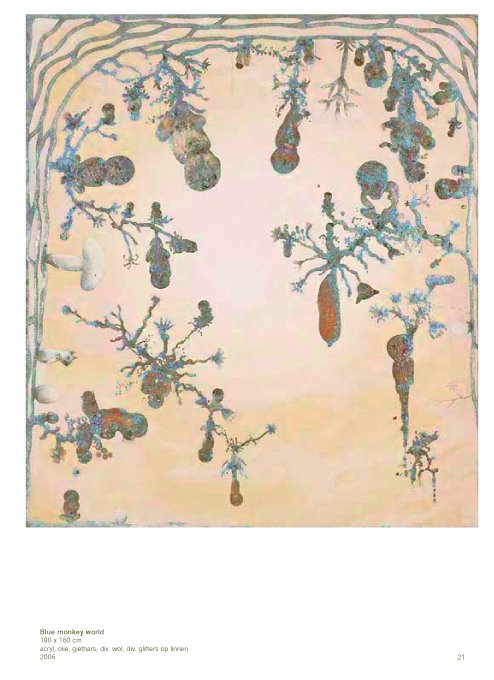
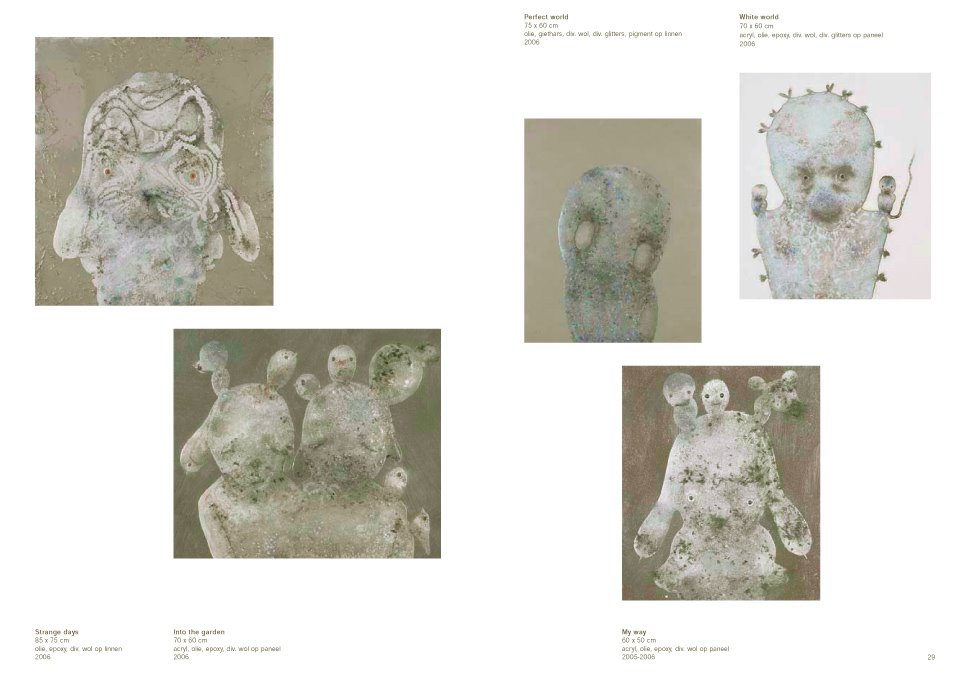
In his first museum solo at the GEM, Hague artist Vittorio Roerade (b. The Hague, 1962) presents work produced over the last six years. In his paintings, Roerade uses unorthodox techniques and materials to fairytale figurative effect. He combines beeswax with photo-collages, pours on epoxy resin, perforates his works and decorates his pictures with hair and embroidery. The main themes of his strange and moving matter paintings are the fragility of human life and the interconnection of everything on earth.

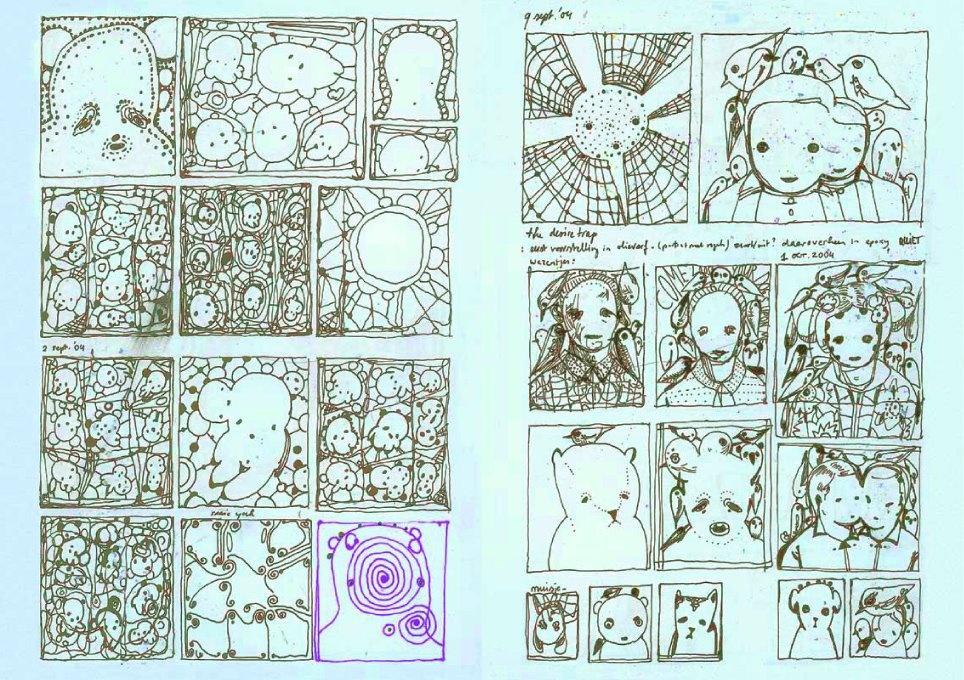
Even though his work is based on sketchbooks full of countless meticulous drawings, Vittorio Roerade has always worked first and foremost as a painter. Into his oil paintings and watercolours he quickly introduced elements of photo-collage. His choice of subject has remained unchanged: man, human relationships and the connection between the individual and the wider world. Portraits play a major role in his oeuvre, both as a mirror of the world and as the bearer of psychological meaning. In a number of striking early series, Roerade obtains a variety of effects through repetition of parts of the human body, such as noses, eyes, hands and feet. The elements often become enigmatic and turn into an abstract pattern, but such repetition can also transform a double portrait into an image of a single fused human being. In some of Roerade’s portraits, however, the nose or mouth is actually missing, making the depiction seem both concentrated and otherworldly. The exhibition at the GEM begins with the ‘wax portraits’ that Roerade was making in 1997-2001: thick layers of beeswax smeared on around the eyes or mouth make it look as if the facial features are having to work their way out through the skin. Later he uses epoxy resin to achieve a still more layered and transparent effect. The brushstroke disappears, making the image still more anonymous. The forms dissolve into the resin and lose their solid outlines. Faces are simplified down to a circular shape adorned with three dots: two eyes and a mouth. Subsequently, Roerade starts to add elements, such as songbirds, which soften the severity of the pared-down image and open it up again. The faces are also more freely represented and start to look like animals or teddy bears.
Roerade’s recent work also reflects another fascination: with structures. Where this was expressed in his early work by means, for example, of a close-up of a hand, revealing the network of fine lines in the skin, patterns of branches and spider webs now occur as independent motifs. Roerade’s interest is unlikely to be purely formal in nature; his concern is with a network of relationships between individuals and with a fundamental structure ultimately underlying the entire material world: the universe in a playful and poetic form. He introduces texts, taken from pop songs, on the subject of love or the beauty of life. These texts, constructed of little holes bored into the smooth epoxy resin, likewise form an abstract pattern, overlying the image like a starry sky. In his most recent paintings, he takes the integration of the individual and the network even further, while at the same time allowing the image ever more freedom

Frits Gierstberg selects participants for Dutch Dare photo exhibition


Works by Elspeth Diederix, Marnix Goossens, Gert Jan Kocken, Anouk Kruithof and Jaap Scheeren, Hans van der Meer, Julika Rudelius, Gerco de Ruijter, Viviane Sassen and Martine Stig, Marike Schuurman, Roy Villevoye and Useful Photography will be represented in Dutch Dare, Contemporary Photography from the Netherlands. This exhibition will run from 19 October to 2 December 2006 at the Australian Centre for Photography in Sydney, Australia.

Frits Gierstberg has compiled the exhibition at the request the Mondriaan Foundation as part of the commemoration of four hundred years of bilateral relations between the Netherlands and Australia. The accompanying catalogue is published by NAi Publishers (ISBN 90-5662-548-9).

"The binding factor in the selection for Dutch Dare is the manner in which these photographers and visual artists blend traditions and genres and turn them upside down, use humour and irony, deploy the documentary and play with it at the same time, taking everyday life as the starting point and managing to develop countless variants of Dutch Primitive realism," explained Gierstberg.

Thursday, August 24, 2006

Netherlands v. Germany


Netherlands v. Germany
Painting / Malerei
21/10/2006 t/m 22/01/2006

The title of this exhibition refers to the rivalry that is part of the collective subconscious of the Netherlands and Germany. The difference in size between the two neighbouring nations has produced a strong David-and-Goliath complex. This is, however, much more deep-rooted in David than in Goliath, as witness the grossly disproportionate euphoria that swept the nation in 1988, when the Dutch team carried off the European Cup with a 2-1 score, achieved in the final moments of a match against Germany played in the then Federal Republic. Historian Friso Wielinga has described the nation’s mood on that day as ‘the rare ecstasy of a small country that had demonstrated its superiority to its larger and more powerful neighbour.’

In a light-hearted nod to the constantly changing social relations between the two countries, this group exhibition will confront three young artists from the
Netherlands with three of their peers from Germany, arranged in three sets: Aaron van Erp and Matthias Weischer, Tjebbe Beekman and David Schnell, and Rezi van Lankveld and Martin Eder. All six artists give a modern twist to traditional romantic themes, each in his own particular way and without shying away from (often subtle) references to the structures, ambitions and anxieties of society today. Matthias Weischer and Aaron van Erp make ‘psychogrammes’: paintings that are an enigmatic depiction of the emotional messiness of modern life. David Schnell and Tjebbe Beekman apply the strategy of the sublime to the contemporary landscape, manipulating the perspective and other aspects so that the viewer feels caught up in something beyond his control. Martin Eder and Rezi van Lankveld produce work in which eros and thanatos are two sides of the same coin – their pictures transport us to the midst of a postlapsarian paradise and delve deeper into the human subconsciousness.

Netherlands v. Germany is intended, therefore to explore various aspects of the romantic sensibility in contemporary art. The choice of artists and the matches between them will not only reveal recent developments in German and Dutch art, but also invite the public to engage in an intensive consideration and comparison of the works on show.

Wednesday, August 23, 2006

Alexandra Leykauf & Lisa Oppenheim in FOAM Amsterdam


24 August to 15 October 2006

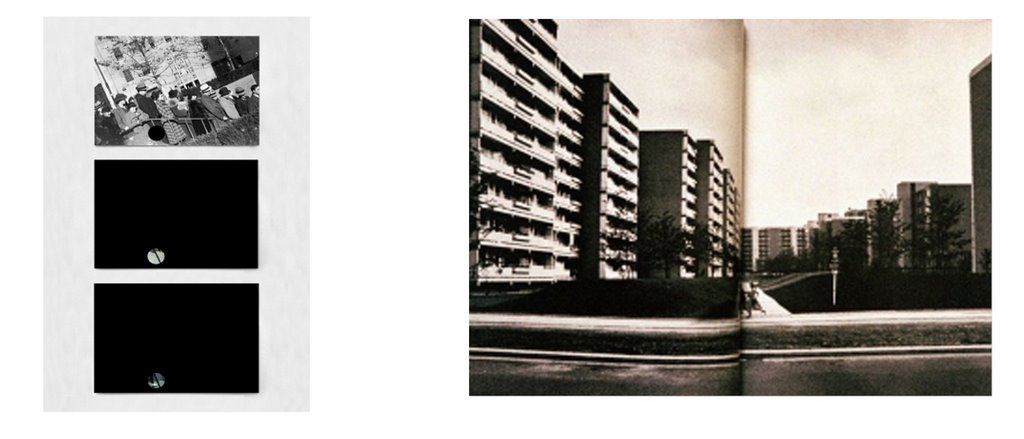
Foam offers a remarkable, combined presentation of work by artists Alexandra Leykauf and Lisa Oppenheim from 24 August to 15 October 2006.Alexandra Leykauf and Lisa Oppenheim both examine the complex interplay between representation, reproduction and conservation of the photographic medium.

By manipulating archive material, rediscovered photos and printed media, they imbue existing images with new meaning and toy with the viewer’s expectations. The theme that runs through both artists’ work is the visualisation of the pictorial mechanism.
Alexandra Leykauf’s work focuses on the different levels at which an image exists. The image as a surface, or as space, as physical substance or abstract suggestion, as a barrier or a bridge, as a border and a crossing between two worlds.

In her ‘Folds’ series Leykauf examines the three-dimensionality of books on a two-dimensional surface. The folds that disturb the depicted image draw attention to both the artificiality of the picture and the imaginary space that it creates. The missing section, in the fold, suggests another space behind the picture, like off-space in film. Imagined space also plays a role in her ‘Hotel des Grottes’ series. This features black-and-white reproductions of a landscape showing a cave and the person who discovered it. What you see is not really a cave, but a black hole, the absence of substance. It is the surroundings that reveal it to be a cave: the viewer has to fill the void with stereotypes and experiences of caves.

Lisa Oppenheim uses documents from American visual archives. By reusing and manipulating historical documents she explores the relationship between image, idiom and time. For her ‘Killed Negatives’ installation she used negatives from the Farm Security’s Administration archive which were perforated to prevent reuse. Underneath Oppenheim places recent photos, taken at the same or similar locations, in the shape of the gaps. As in Leykauf’s series spaces are created, here filled by photography, drawing together history and the present day.
Similarly, for her ‘Damaged’ series Oppenheim used the photo archives of the Chicago Daily News. She printed parts of damaged negatives onto newsprint, suggesting their original context, and placed the original caption below. The texts refer to specific moments in history, apparently unconnected with the image. It suggests the passing of time since the picture was taken and the ultimate decay of the image.

Alexandra Leykauf (b. 1976, Nuremberg, Germany), graduated in 2002 at the Rietveld Academie in Audiovisual Art and Photography, and spend a work period in 2003 and 2004 at the Rijksacademie van Beeldende Kunsten in Amsterdam. Leykauf has shown work at Galerie Barbara Wien, Galerie Chez Valentin, Paris (2004), and Galerie Martin van Zomeren (2004 and 2005), her representative.

Lisa Oppenheim (b. 1975, New York) graduated in 2001 at Milton Avery Graduate School for the Arts, in Film/Video and studied at Rijksacademie van Beeldende Kunsten in Amsterdam in 2004. Oppenheim has exhibited at Nederlandsche Bank, Amsterdam, Fries Museum, Leeuwarden, Galerie Juliette Jongma, Amsterdam (2005), Stuart Shave/Modern Art London (2006). Lisa Oppenheim is represented by Galerie Juliette Jongma.

Monday, August 21, 2006

Sunday August 20, 2006The Observer , Deyan Sudjic


My career as architecture critic at The Observer began shortly after the turn of the millennium with a test flight on the London Eye. I remember cautiously scrutinising the capsules lashed, apparently precariously, like soap bubbles, to the elegant white structure. But rather than marvelling at its jewellery-like precision, uppermost in my mind was the question of how was I going to get down if the thing got stuck a couple of hundred feet up in the air.
The Eye was an object that had all the makings of a fiasco. The word was that it would be brash, ugly and vulgar, which just goes to show the danger of rushing to judgement. In an effort to strangle it at birth, Lord St John of Fawsley, chairman of the soon-to-be-abolished Royal Fine Art Commission, had been quite astonishingly rude to its architects, Julia Barfield and David Marks, when their plans came to him for scrutiny. And even after it had finally been floated down the Thames to its site opposite the Palace of Westminster, the first attempt to lift it from its prostrate position ended in highly public failure. But despite all the flak, it was on the verge of turning into one of the world's instantly recognisable and most popular landmarks.

On the brink of a once-in-a-century transformation of London, it was also the best vantage point to take a look at the new shape that architecture was taking in Britain. Back in 2000, you could still glimpse Canary Wharf's original tower, standing in solitary state. The thicket of new structures that now hems it in on every side was still taking shape. The Swiss Re tower was no more than a planning application. There was no new City Hall.
The success of the Eye has certainly been hugely important in making Britain far more receptive to the idea of radical new architectural intrusions than it has been at any time since the early Sixties. For me, it was the point of departure for a white-knuckle ride that has ended up taking me far beyond London. In the past six years, I've been to see Novy Dvur, the first new monastery built in eastern Europe for half a century, to watch a Cistercian abbot celebrate mass in John Pawson's exquisite chapel there.
I've trudged over the sand and dust of the building sites of Beijing with their tens of thousands of migrant labourers looking like warring medieval armies working under their ragged flying banners. I've boggled at the sprouting skyscrapers of Shanghai, with tops that look like giant pineapples.
I have been to Porto's concert hall, Seattle's public library and the new Dutch embassy in Berlin, all in the company of their architect, Rem Koolhaas. It was only in the embassy that I found myself in any actual physical danger from an architect who uses 'brutal' as a term of praise. Temporarily overwhelmed by his eloquence, I managed to walk straight into one of his razor-edged steel staircases and narrowly escaped becoming a casualty of a man unsure whether being a mere architect is enough for his degree of intellectual ambition.
I have met Albert Speer's son, also an architect and equally addicted to making grand architectural gestures. I have wondered at his friendship with Peter Eisenman, the American architect of Berlin's Holocaust memorial built on top of his father's wartime bunker.
Thomas Krens, the egregious director of the Guggenheim, has fed me brandy and profiteroles in his favourite Bilbao restaurant and explained the limitations of certain of his trustees. In Tokyo's glossiest shopping streets, I've seen the way that the fashion world is building rival architectural trophies: Herzog and de Meuron for Prada, Renzo Piano for Hermes, Toyo Ito for Tods, Kazuo Sejima for Dior.
Britain's burst of high-profile architecture has spilled across the whole country, from the Eden Centre in Cornwall to the transformation of both banks of the Tyne with the Baltic Gallery and Norman Foster's concert halls in Newcastle. Manchester, Liverpool, Glasgow, Birmingham and Leeds have all started being interested in building skyscrapers. I have wandered through the toughest suburbs of Manchester exploring post-modern housing and listening to the wind whistling through Thomas Heatherwick's vast steel monument, B of the Bang. I have looked at de Rijke Marsh Morgan's work helping turn around a failing school in Dulwich. I have been to Birmingham to see Future Systems' extraordinary department store for Selfridges and explored the even more extraordinarily costly Scottish parliament.
I have peered over the lip of Ground Zero and cautiously ventured into the tip of the Swiss Re tower while the last sheets of glass were being inched into place. The latter was an experience even more troubling to those uncomfortable with heights than the Eye. 'Is there,' you can't help wondering, 'some sort of predisposition among architects to vertigo, and a compensating tendency to design buildings that force them to confront their fears?'
What makes architecture such an all-absorbing, endlessly fascinating subject to write about is that it is so intimately connected with the hard stuff of power, politics and city building. Architectural creative energy is irresistibly drawn to those places in the globe that are going through the fastest transformations. It reflects ambitious cities and individuals determined to make a mark and the birth of new economic and political systems in a sometimes-lurid glow.
If you had followed the flying circus of the perpetually jetlagged tiny group of architects that built so much high-profile architecture two decades ago, you would have found yourself in Tokyo. Now it is in Beijing, Moscow, Dubai and, perhaps most unexpectedly, London that they are spending most of their time.
To talk about what architecture has been about in the last few years has meant focusing more on the 'why' rather than the 'how'. Which is to say that exploring what is making a building happen is sometimes a more challenging - but also more rewarding - issue to address than what the results look like. The five schemes for 1,000ft skyscrapers that have been approved for central London since Ken Livingstone went to Shanghai and decided that Britain's financial centre needed to replicate its skyline have their own aesthetic issues. Richard Rogers's high-rise wedge overlooking the Swiss Re will be a more interesting building than Rafael Vinoly's, which resembles a giant telephone handset. If it is built, it will offer more social space to the city around it.
But to focus just on how these towers will look is to miss much of the point. What really matters is to try to understand why people would suddenly think that building tall in London is a good idea after so many years in which it seemed like exactly the opposite. While appreciating Renzo Piano's craft-based approach to design is obviously an issue in evaluating the quality of his so-called Shard of Glass, Europe's tallest tower, approved for a site at London Bridge, perhaps even more critical to understanding its meaning is to explore the significance of a situation in which Livingstone is prepared to act with all the imperial majesty of a Francois Mitterrand or a Nelson Rockefeller.
Like Rockefeller, who, as governor of New York State made the Twin Towers possible by renting space in them for his civil servants, Livingstone has not only pushed the tower through the planning system because he liked the look of it, but he has also enormously boosted its chances of actually being built by signing a contract to house Transport for London's hundreds of employees there, even though its construction timetable is still far from clear.
In terms of the language of contemporary architecture, we have seen the battle of the Eighties between the Prince of Wales and those members of the architectural profession not interested in adopting period fancy dress transmogrify into an even more vicious internecine fight between the blob builders and the box designers. The new technical freedom to adopt virtually any shape for a building has made architecture closer to pattern-cutting a computer-generated skin to clothe a structure than to traditional building.
You can see the phenomenon in the work of a generation of architectural talent that in some cases took a long time to start building. Zaha Hadid, for example, collected the Pritzker Prize before her major projects started opening their doors. David Chipperfield has finally started to pick up commissions at home. While Hadid and Chipperfield have developed distinctive personal voices in their work, it is Herzog and de Meuron which has emerged as perhaps the most creative, large-scale architectural practice in the world, precisely because it approaches each project as if it were its first.
At the same time, we have lost some architects who should have lived longer, in particular Enric Miralles who died cruelly young without seeing his Scottish Parliament completed.
Writing for a newspaper is an exhilarating, distracting drug. It gives you the illusion of achievement simply by meeting the deadline and getting into print. It also gives you every opportunity to make embarrassingly elementary mistakes and the kind of errors of judgement that happen when you are in a hurry. And newspapers give critics the illusion of influence. I understand that I might once have mildly upset John Prescott by something I had written, but I have no delusions that criticism can do much more. Thankfully, British papers are not burdened with the massive self-regard of certain American newspapers, which labour under the misapprehension that their architecture critic's words amount to law. What you can do is record, entertain and, occasionally, abuse.
Has architecture improved in the past six years? We certainly like to think it has. And certainly there is a lot more of it and, in particular, a lot more conspicuous architecture than there used to be. Some architects have emerged in better shape than expected. Norman Foster's growth, for example, has proved unstoppable. He is now talking about maintaining an office of 1,000 people in the near future.
On the other hand, Daniel Libeskind has shown himself to be a less interesting architect than we hoped he would be at the time he won the Ground Zero competition that turned out to be neither a genuine competition, nor a real victory. Santiago Calatrava has been given the rope to hang himself, building not just the soaring bridges that made his name, but a series of buildings that has come out far the wrong side of kitsch.
Will Alsop has proved himself to be uncrushable in the face of being forced to sell his practice twice in two years to keep his creditors at bay, and unembarrassable in his wilfulness, even after his biggest British project to date, the community arts centre in West Bromwich known as the Public, had to call in the receivers before it opened and despite soaking up £40m in public money.
But perhaps the most remarkable development is the sudden popularity of contemporary architecture, which is no longer limited to insiders and government departments. Ikea persuaded us all to chuck out our chintz. Grand Designs and Wallpaper* have transformed the look of the contemporary kitchen extension. Developers such as Urban Splash, with its plans to turn rotting brutalist hulks of social housing into fashionable apartments, have made Sixties style the new Art Deco. And John Pawson got a name check on The Archers
Being able to spend so much time looking at extraordinary, memorable and occasionally beautiful architecture has been a continual pleasure. It is a slightly unreal bubble from which to look at buildings. Nobody but an architecture critic sees such a vast range of buildings with such a huge geographic spread in quite such a short space of time. Users can occupy a building for a lifetime and they stop seeing the architecture almost immediately. The critic sucks a building dry of material and moves on in 25 minutes.